
What does OSHA actually require for handwashing on a job site?
OSHA splits this into two rules, and contractors mix them up constantly. 1926.51(f)(1) applies specifically to work involving paints, coatings, herbicides or insecticides, or similar contaminant exposure. It does not cover every construction site by default. Separately, 1926.51(c) sets toilet ratios: one facility for 20 or fewer workers, then one toilet seat and one urinal per 40 workers up to 200, and one per 50 above that, a ratio also worth checking against the OSHA portable toilet requirements guide. Handwashing and toileting get lumped together in casual conversation, but they are different obligations with different triggers. If your Reno crew is framing and pouring concrete with no chemical spraying, you may not hit the (f)(1) threshold. Add exterior coatings or pesticide work and you do. Reno Porta Pros can walk a site plan and tell you which rule actually applies before you request a quote. Pairing a handwashing station rental with your portable toilet rental order covers both angles at once, and it is simpler to service on one route than two separate deliveries scheduled apart.
How many handwashing stations does a Reno crew need?
One station per 20 workers is the baseline most contractors use, matching the same headcount logic behind OSHA's toilet ratio in 1926.51(c). A 15-person framing crew usually runs fine with a single unit; a 60-person site needs three, spaced so nobody walks far to reach one. Distance matters more than people think. ANSI/PSAI Z4.3 sets a service interval of once a week for up to 10 users across a 40-hour week, which is the baseline your pumping schedule should follow once units are placed. If your crew works two shifts, or if the trades using paint and coatings are a subset of a larger site, put stations near that specific work zone rather than only at the entrance. A portable sink rental next to a mixing station covers the (f)(1) trigger directly, and a standard porta potty rental placed alongside it keeps both obligations in one spot. For headcount math on toilets alongside washing, the how many porta potties do I need guide breaks down the same ratio logic in more detail.

Where should handwashing stations go on site?
Put them next to the work that creates the exposure, and next to the toilets, not across the lot from either. If crews are applying coatings on the east side of a Reno build site, a station at the west entrance does nobody any good. ADA Standards section 403.5.1 requires a 36 inch clear route to any accessible unit, and section 304.3.1 calls for a 60 inch turning circle at the fixture itself, so stations serving an accessible portable toilet need that clearance too. A standard portable toilet runs about 44 by 48 inches on the ground, and station footprints are usually smaller, so clearance is rarely the limiting factor once you account for approach paths. Reno's clay-heavy soil turns soft fast after storms rolling in from the Sierra, so gravel or plywood pads under stations near Sparks or out toward Verdi, 9.6 miles west, keep units from sinking. Pair placement with your temporary fence rental layout so the route to the station stays inside the secured perimeter, check the porta potty placement guide for pad and clearance specifics, and route power for lit sites through a temporary power pole rather than an extension cord across the walkway.
Do special events and food vendors need handwashing stations too?
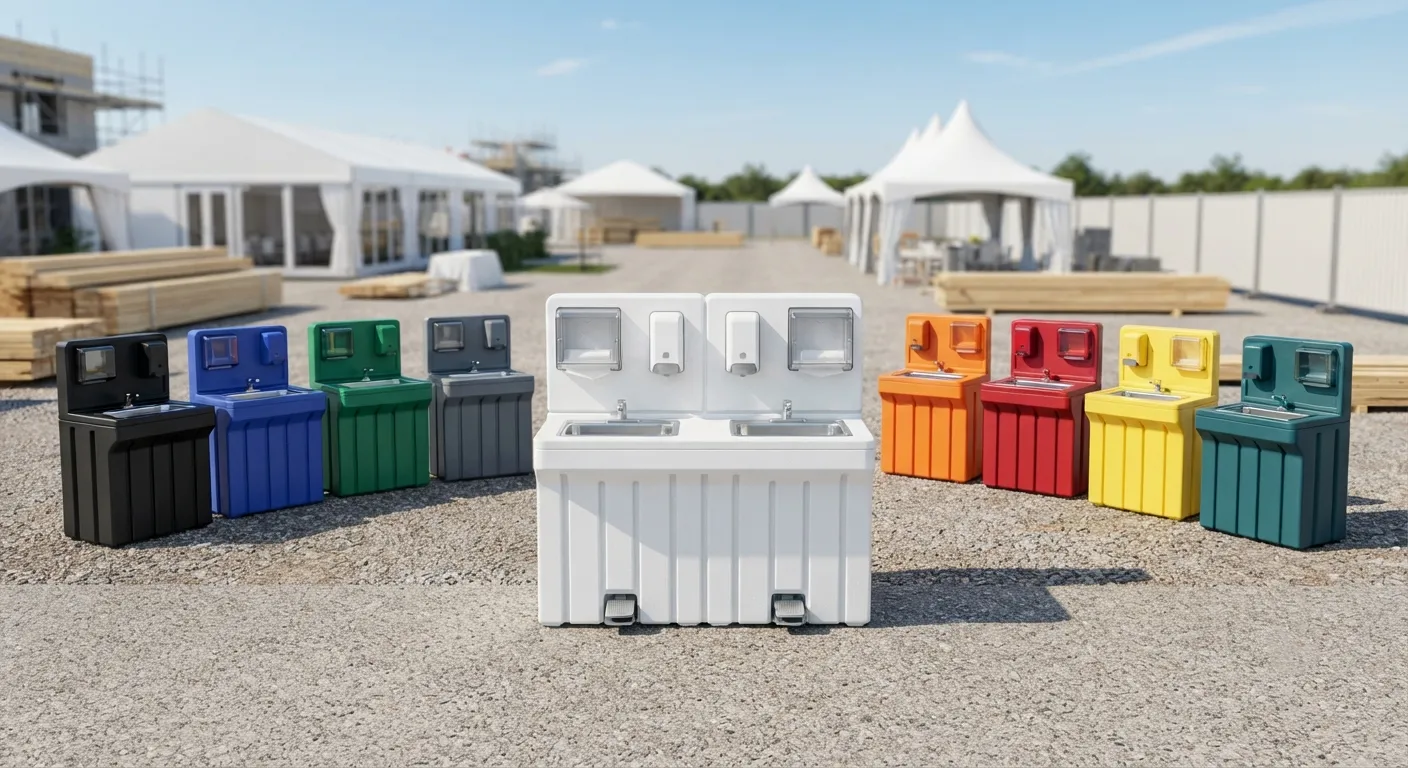
Yes, and often more than a construction crew would guess. Food vendors handling raw ingredients need washing capability regardless of paint or chemical use, because health code expectations run separate from OSHA's contaminant-triggered rule. A wedding caterer at a Reno venue, a food truck row at a festival, or a beer garden all need a sink with soap and towel access near the prep area. This is a health and hygiene expectation, not just a labor rule, so it applies even when no OSHA trigger exists. Event planners booking event restroom rental or a wedding restroom rental package should add a station at the same time, since retrofitting one in after guests arrive is a hassle. Larger events, like a festival restroom rental or county fair restrooms setup, typically need a station at every food or drink point, not just one central location. A restroom trailer rental with a built-in sink can cover both needs in one unit for higher-end events, and a luxury restroom trailer works well for a golf outing booked through golf tournament restrooms.
FAQ
Does hand sanitizer count as a handwashing station under OSHA?
No. 29 CFR 1910.141(d)(2) specifically requires soap and towels or a hand drying device. Sanitizer dispensers don't meet that standard on their own. If your Reno site is relying on sanitizer only, add a hand sanitizer station rental as a supplement, not a replacement for a real washing unit.
Is a handwashing station required if my crew isn't using paint or chemicals?
Not under 1926.51(f)(1), which only applies to paints, coatings, herbicides, insecticides, or similar contaminant exposure. General toilet facilities still fall under 1926.51(c). Check your scope of work before assuming you're exempt, since scope often changes mid-project, and construction crews planning a broader buildout should review construction site services for the full sanitation picture.
How often do handwashing stations need to be serviced?
ANSI/PSAI Z4.3 sets a baseline of one service visit per week for up to 10 users over a 40-hour week. Busier sites or events need more frequent visits. Reno Porta Pros schedules around actual headcount rather than a flat weekly default, the same logic used for how often are porta potties cleaned on toilet units.
Can a handwashing station be shared between toilet and food prep areas?
It can, but placement matters. A station serving both needs to sit within reasonable reach of each zone, not centered so far away that one side is neglected. On larger layouts, two stations often work better than one shared unit stretched thin, similar to how a 4 stall restroom trailer beats a single unit for a big food court zone.
What size clearance does an ADA handwashing setup need nearby?
ADA Standards section 403.5.1 calls for a 36 inch clear route, and section 304.3.1 requires a 60 inch turning circle at the fixture. Pair these with an ADA accessible porta potty so the whole cluster meets the same clearance standard.
Next step
Get a delivery date
Tell us the address, the dates and the headcount. We size the order and confirm the route.